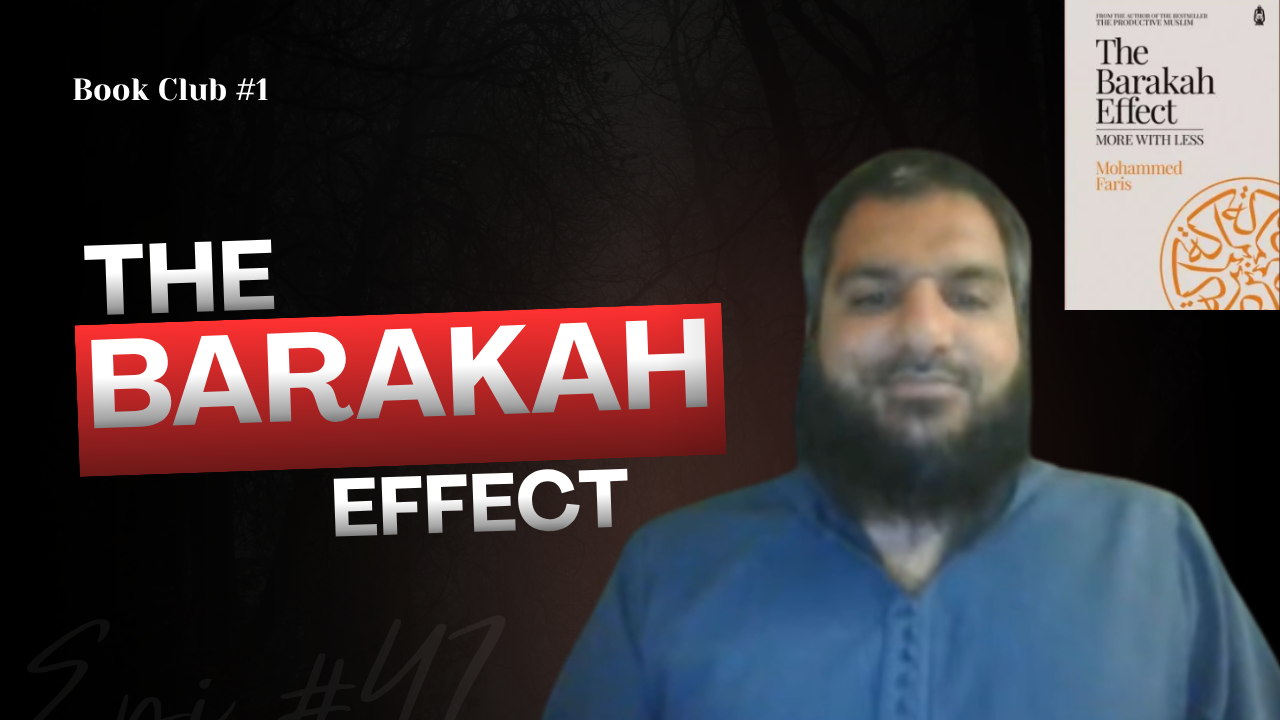
Hustle Culture vs. Barakah Culture: Rethinking What It Means to Be Successful
This article and video is based on the book The Barakah Effect. Read our review of the book here, or purchase a copy here.
Hustle Culture vs. Barakah Culture: Rethinking What It Means to Be Successful
We live in a world that constantly tells us to do more, earn more, achieve more, and become more.
The language of modern productivity can be inspiring, but it can also become exhausting. We can easily reach a point where we feel guilty whenever we are not working, pursuing a goal, building a business, advancing our careers, or improving ourselves.
But is this really the Islamic approach to life?
One of the most thought-provoking books I have read in the field of Islamic personal development is Muhammad Faris’s The Barakah Effect: More with Less. I found the book so beneficial that I even taught parts of it to my children during homeschooling, and I later met the author personally to thank him for writing it.
One of the book’s most important discussions is the contrast between hustle culture and Barakah culture. This distinction challenges many assumptions we have absorbed about work, productivity, wealth, and even what it means to live a successful life.
What Is Barakah?
Barakah is one of those Islamic concepts that is difficult to translate into a single English word. It can be understood as a divinely granted increase or blessing that causes something to produce more benefit than we would ordinarily expect. We can experience Barakah in many things.
Barakah in time
Barakah in time means being able to accomplish meaningful things within a limited amount of time. When we study the lives of the scholars and righteous people of the past, we often find people who did an extraordinary amount of work despite having relatively short lives. They wrote, taught, worshipped, raised families, served their communities, and contributed to civilization. Their lives were not necessarily longer than ours. Their time simply contained more benefit.
Barakah in food
Sometimes a small amount of food seems to be enough for far more people than expected. You prepare a meal thinking it will only be enough for your family, unexpected guests arrive, and somehow everybody eats. That is an example of Barakah.
Barakah in wealth
You may have a difficult month financially, yet somehow your money stretches far enough to cover everything you genuinely need. You did not suddenly become wealthy. Rather, the wealth you had proved sufficient.
Barakah in our efforts
Sometimes a small action produces an enormous and lasting impact. A single good deed, a book, a lesson, an act of kindness, or a decision made sincerely for Allah may continue benefiting people long after we have forgotten about it. That is Barakah.
The important point is that Barakah is ultimately a gift from Allah. It can enter both tangible things and intangible things such as time, wealth, effort, places, and relationships. Most importantly, something that genuinely contains Barakah should ultimately bring us closer to Allah.
How Did We Lose Our Barakah?
One of the striking observations in The Barakah Effect is the contrast between the lives of earlier Muslims and the experience of many people today.
Earlier generations accomplished extraordinary things while also making time for Salah, family, community, and other responsibilities. Today, by contrast, many people constantly complain that they have no time. They feel that life is moving too quickly, that money disappears immediately, and that they are always busy but rarely feel satisfied.
Why?
One explanation offered in the book is that we have absorbed a worldview built around hustle culture.
When Work Becomes Your Life
One of the biggest problems with hustle culture is that it can turn work from a means into an end. For many people, their career has become their identity. Their lives revolve around advancing professionally, earning more money, gaining the next promotion, and achieving the next title. Work has effectively become their life.
But the Islamic worldview gives work a different place.
Work is important. Earning halal income is important. Providing for one’s family is important. Excellence in one’s profession is important.
But work is still one part of life.
It is a means of providing for ourselves and our families, serving others, and fulfilling our responsibilities. It should not consume every other dimension of our existence. Work is ultimately a means of providing for the family, while religion, family, and health have a higher priority. This is a radically different mindset from the idea that our worth is determined by our professional productivity.
The Five Drivers of Hustle Culture
Muhammad Faris identifies five major forces that contribute to hustle culture:
- Materialism
- Individualism
- Capitalism
- Consumerism
- Fear of debt
These forces are interconnected and can create a worldview in which people feel that they must constantly work, earn, consume, and accumulate before it is too late.
Let’s look at each one.
1. Materialism: When the Dunya Becomes the Goal
Materialism here does not mean the philosophical doctrine. It refers to excessive attachment to worldly possessions and wealth. The problem is not owning nice things.
Islam does not demand that Muslims live in poverty. You can have a beautiful home, a comfortable car, good clothing, and financial security.
The question is:
Where is your heart?
Are these things simply tools that you use, or have they become the measure of your success? When accumulating wealth and possessions becomes an obsession, it can damage our relationship with Allah, our families, and our communities. We need to remember that possessions are temporary.
One of the most liberating things we can do is learn not to attach our hearts to things. Things come and go. What matters far more is our relationship with Allah, our families, our health, our communities, and the good that we leave behind. Wealth should be in our hands, not in our hearts.
2. Individualism: The “Me” Culture
Individualism is another major force behind hustle culture. There is nothing inherently wrong with individuality. Islam recognizes that every person is responsible for their own beliefs, actions, choices, and character. But Islam does not teach us to live as isolated individuals.
We are simultaneously individuals and members of a community.
Our spouses have rights over us. Our children have rights over us. Our parents have rights over us. Our neighbors have rights over us. The poor have rights over us. We therefore have personal responsibilities and collective responsibilities.
Hustle culture can push people towards an extreme form of individualism in which everything becomes about my goals, my career, my success, and my ambitions. Eventually, relationships become obstacles. Family becomes an inconvenience. Community becomes something that takes up valuable time. Even religion can become secondary if it interferes with personal ambitions.
This is not the Islamic balance.
The Islamic model is neither extreme collectivism nor extreme individualism. It is a balance between personal responsibility and responsibility towards others. And this matters because relationships require time.
If we spend our entire lives pursuing individual goals while neglecting family and community, we may eventually find ourselves successful on paper but profoundly lonely. The Prophet ﷺ taught that the person who mixes with people and patiently bears their difficulties is better than the person who isolates themselves from people.
There will always be inconveniences when living with others. Families argue. Friends sometimes disappoint us. Communities can be difficult. But relationships are worth the effort.
And maintaining family ties is itself a source of Barakah.
3. Capitalism: The Endless Pursuit of More
One of the simplest stories illustrating the difference between hustle culture and Barakah culture is the story of the American banker and the Mexican fisherman. A fisherman catches enough fish to support his family and then spends the rest of his day relaxing and enjoying life. A banker sees an opportunity to build a much larger business.
He explains that the fisherman could catch more fish, hire employees, expand his operation, make much more money, and eventually become wealthy.
“Then what?”
Eventually, the banker explains, he could retire to a beautiful place and spend his days relaxing.
The fisherman responds, in essence:
“But I’m already doing that.”
The story captures an important question:
What exactly are we working towards?
Hustle culture often tells us that enjoyment must come later.
Work now. Sacrifice now. Build now. Enjoy life after retirement.
But there is no guarantee that we will reach that future.
Islam teaches us to value the present as well. Spend time with your family today. Enjoy nature today. Rest today. Worship Allah today. Appreciate the blessings you already have today.
This does not mean abandoning ambition or becoming lazy. The fisherman in the story still worked. He simply worked enough to meet his needs rather than turning work into an endless pursuit of more.
4. Consumerism: Always Wanting the Next Thing
Consumerism takes materialism one step further. It is the constant desire for more. You have a house, but now you want a bigger house. You have a car, but now you want a better car.
You have a phone, but now you need the latest model. You buy something and immediately start thinking about what you will buy next. The problem is that there is no natural endpoint.
There will always be a newer phone, a larger house, a more expensive car, a more fashionable wardrobe, and another product being marketed as something you supposedly need. If happiness depends upon obtaining the next thing, happiness will always remain one purchase away.
At some point, we need to learn the art of contentment. If your home is adequate, enjoy it. If your car gets you where you need to go, appreciate it. If your possessions fulfil their purpose, be grateful for them. There is nothing wrong with improving your circumstances. But constantly comparing what you have with what others have is a recipe for dissatisfaction.
5. The Fear of Death
The final driver of hustle culture discussed in the transcript is the fear of death. Modern society can create enormous financial pressure. People become convinced that they must earn more, work more, and accumulate more because they are terrified of falling behind.
This fear can eventually consume a person’s life. One antidote is to remember our mortality. We are human beings. We are going to die. That does not mean we should be irresponsible or ignore our financial obligations. Rather, it means we should put them into perspective.
You do not need to become a millionaire for your life to have value. You do not need an impressive job title to have lived a meaningful life. If you have a loving family, worship Allah, fulfil your responsibilities, and are moving towards Jannah, your life is not being wasted.
We Need to Learn How to Enjoy Life
Perhaps one of the most important lessons here is that enjoying the halal is not the opposite of being productive or religious. Sometimes Muslims develop an unnecessarily austere understanding of Islam. We start feeling guilty for relaxing, enjoying nature, spending time with family, pursuing hobbies, or simply having fun.
But if something is halal and we are fulfilling our responsibilities, there is no reason to feel guilty about enjoying it. Allah has blessed us with this world.
Enjoy your family. Enjoy your friends. Enjoy nature. Enjoy your hobbies. Rest when you need to rest. Laugh. Travel. Eat good food. Take a walk. Spend an afternoon with people you love.
These things do not have to compete with spirituality. They can become part of a balanced Muslim life.
The key is not to become so attached to worldly enjoyment that we forget Allah. Rather, we should enjoy Allah’s blessings while remaining grateful to Him.
Productivity Is Not the Same as Being Busy
One of the clearest signs that hustle culture has affected us is our obsession with being busy.
Ask someone how they are doing and one of the most common answers is:
“I’m busy.”
Being busy has almost become a status symbol. But being busy does not necessarily mean being productive. You can spend hours in meetings and accomplish very little. You can answer emails all day and achieve nothing meaningful. You can fill your calendar completely and still neglect your family, health, worship, and personal growth.
Sometimes people even feel compelled to look busy.
The result is that precious time that could have been spent thinking, resting, exercising, worshipping, or connecting with family is consumed by activities that exist primarily to make us appear productive. This is not Barakah.
Barakah is not about squeezing more and more activity into every available minute. It is about doing what matters, with the time and resources Allah has given us, and seeing those resources produce meaningful benefit.
A Different Definition of Success
The biggest mindset shift is to stop asking:
“How can I fit more work into my life?”
and start asking:
“How can I build a life that Allah puts Barakah into?”
Those are very different questions.
The first can lead to endless hustle. The second forces us to think about our priorities.
Is my Salah healthy?
Are my relationships healthy?
Am I present with my children?
Am I taking care of my body?
Do I have time to think?
Do I have time to rest?
Do I have time to serve others?
Am I earning halal income?
Am I content with what Allah has given me?
Does my work bring me closer to Allah or gradually pull me away from Him?
These questions lead us towards a more holistic understanding of success.
Work Is Only One Part of Life
The central lesson I took from this discussion is simple:
Work is one part of life, not the entirety of life. Your religion matters. Your family matters. Your health matters. Your community matters. Your relationships matter. Your mental and emotional wellbeing matter. Your time with Allah matters. Your ability to enjoy the halal matters.
Work has a place within this picture, but it should not swallow the picture. We should not make our careers our personalities. We should not feel guilty whenever we are resting. We should not measure our worth by our productivity.
And we should not postpone all enjoyment until some hypothetical future when we have finally “made it.”
Instead, learn to be present. Learn to be content. Learn to enjoy the phase of life Allah has placed you in right now.
That is part of living with Barakah.
Escaping the Hustle
For some people, this may require nothing more than changing their mindset. For others, it may require significant changes to their lifestyle, career, or environment.
We should ask ourselves honestly:
What would my life look like if I stopped trying to maximise everything?
Perhaps you would work fewer hours. Perhaps you would spend more time with your children. Perhaps you would reconnect with relatives. Perhaps you would stop buying things you do not need. Perhaps you would delete some social media apps. Perhaps you would choose a simpler lifestyle.
Perhaps you would finally give yourself permission to rest. These changes do not necessarily make you less ambitious. They may simply mean that your ambition is now directed towards the things that actually matter.
As I reflected on this personally, I realised how much difference it can make to step outside of hustle culture. A life with more time for family, nature, friends, rest, and meaningful work can be considerably more peaceful and fulfilling.
The goal is not to do less for the sake of doing less. The goal is to do what matters, and allow Allah to put Barakah into it.
More With Less
That is ultimately what makes the concept of Barakah so beautiful. Modern productivity often tells us:
More. Faster. Bigger. Next.
Barakah culture teaches us something different:
Meaning. Balance. Contentment. Quality. Blessing.
We still work. We still pursue goals. We still build businesses and careers. We still strive for excellence. But we refuse to allow those things to become our gods.
We remember that our Rizq comes from Allah. We remember that our time is a trust. We remember that our families have rights over us. We remember that our bodies have rights over us. We remember that our communities have rights over us. We remember that this dunya is temporary.
Perhaps the real question is not:
“How much can I accomplish in my lifetime?”
but:
“How much good can Allah bring through my life?”
That is the shift from hustle culture to Barakah culture.
And perhaps that is how we learn to have more with less.
This article and video is based on the book The Barakah Effect. Read our review of the book here, or purchase a copy here.