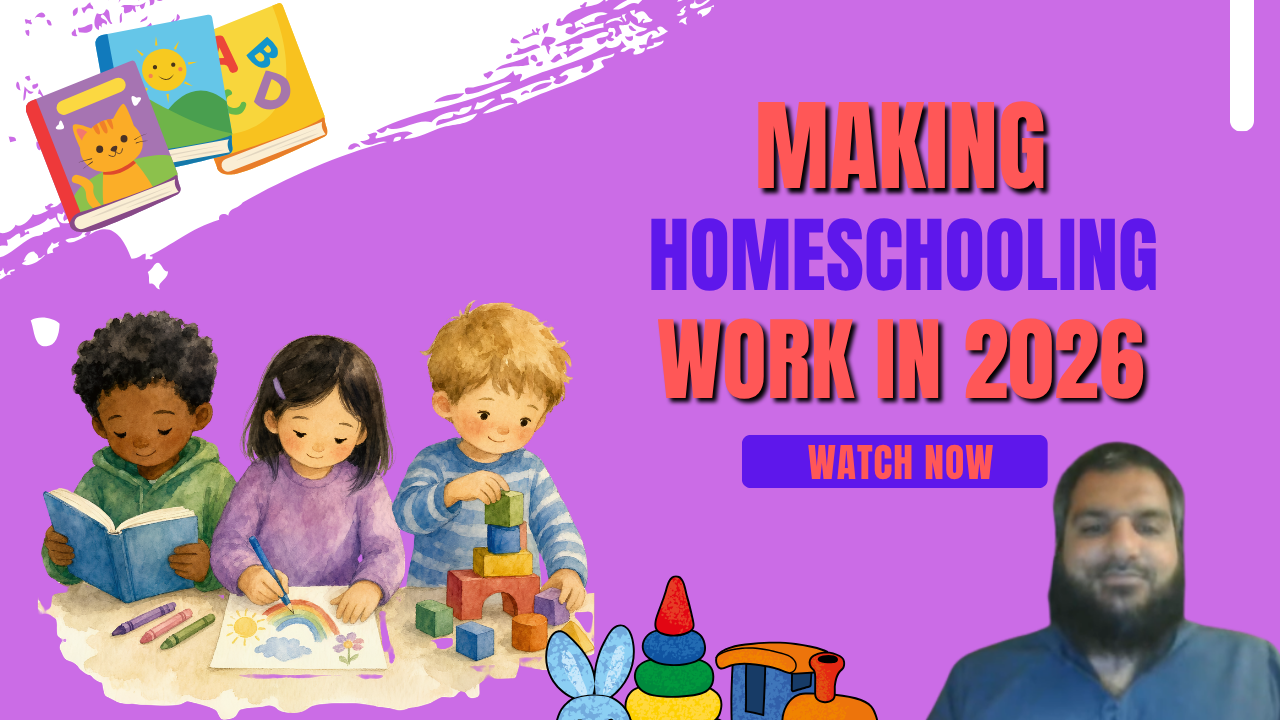
How to homeschool successfully in 2026
7 Tips for Making Homeschooling Work in the Modern World
Homeschooling is not easy. It is not for everybody, and it is not the right choice for every family or every situation.
But after more than twelve years of homeschooling my own children, I have come to appreciate just how much freedom and opportunity homeschooling can provide. It has allowed us to design an education around our children’s needs, interests, personalities and faith rather than simply following a standard system.
Our homeschooling journey is now coming to an end. My eldest is on the verge of graduating, while the others are within a year or two of completing their schooling. Looking back, it has been a long, difficult, interesting and rewarding journey.
I want to share seven lessons from that journey that I think can help parents who are considering homeschooling or are already on the homeschooling path.
My Journey into Homeschooling
My journey as a homeschooler actually began with my own education.
I went to school until Grade 8 and then left school at the age of thirteen to pursue Islamic studies full-time. At the same time, I still wanted to complete my schooling, so while studying at a madrasa in the Alimiyah programme, I continued my school education from home.
There were no online schools at the time. Instead, I used correspondence schools. They would mail me the work, I would complete the assignments and then mail them back. Eventually, I graduated from the Alimiyah programme and high school around the same time, and later completed my bachelor’s degree online.
When I got married and had children of my own, I began thinking about what kind of education I wanted for them. Interestingly, homeschooling wasn’t even on my radar at first. I didn’t really use that word. What I had done growing up was simply called distance learning.
I looked at the schools in my area, but I wasn’t particularly happy with the options available. At the same time, my eldest was reaching the age when I needed to make a decision about his education. Then I attended a webinar by a parent who was homeschooling her children. What she shared impressed me, so I decided to give homeschooling a try. I also met with a local life coach who was homeschooling his own children. His advice was simple: try it for one year. If it doesn’t work, send the children to school afterwards. That was around twelve or thirteen years ago.
Twelve years later, my eldest is preparing to graduate, and the rest are not far behind. We began homeschooling around 2013 or 2014. The years before COVID were some of my favourite memories. Then the pandemic happened and homeschooling became much more complicated. During that period, many families around the world suddenly found themselves educating their children at home, and I found myself advising other parents on how to navigate it. For some of the high school subjects, we used online schools because there were subjects that were difficult for me to teach myself.
But now, as we approach the end of our homeschooling journey, we have gone back to the simpler approach we used when the children were younger. I teach them for around two or three hours a day. Then they spend another few hours teaching themselves things that interest them. Over the years, this has led to some interesting results. One of my children taught himself professional video editing. Another taught himself video game graphics design. They have pursued sports, hobbies, technology, reading and other interests.
I still sit down with them to teach Islamic subjects and the school subjects that need to be covered to ensure that we remain within the requirements of the relevant education system. But as the children have become older and more self-motivated, homeschooling has actually required less of my time.
When they were younger, there were fewer academic subjects but much more focus on physical activity, social interaction, play and simply allowing them to experience childhood. Looking back at this entire journey has taught me a lot about what homeschooling can be.
Here are seven lessons I would share with other parents.
1. Take Calculated Risks
One of the biggest lessons I have learned is that sometimes you have to be willing to take a risk. As a community, we can sometimes become very risk-averse. We want to follow the safest and most familiar path: go to school, go to university, get a job and work towards retirement.
But the world has changed. A university degree is no longer a guarantee of lifelong employment, and the traditional path does not necessarily provide the security that people once assumed it would. Of course, I am not advocating reckless decisions.
When I talk about taking risks, I mean calculated risks. Research the situation. Consult people with experience. Make a plan. Consider the advantages and disadvantages. Make shura. Pray istikhara. Then make a decision.
Homeschooling can certainly feel like a huge risk. You are choosing a path that perhaps nobody else in your family is taking. You may worry about whether your children will be able to return to school. You may worry about university admissions. You may worry about whether you are capable of teaching them. Many of these fears can be reduced through research and preparation.
In my experience, schools were generally willing to accept homeschooled children back into the appropriate grade, usually based on their age, previous records and an entrance assessment. The exact rules obviously vary from country to country and school to school, so this is something every family needs to research for themselves.
I also found that university was less complicated for homeschoolers than I had expected. There are multiple pathways into higher education, depending on the country and institution. The important point is not that every homeschooler will have exactly the same experience. The point is that you should investigate the actual options instead of allowing fear of the unknown to make the decision for you.
When we first began homeschooling, it was one of the most anxiety-inducing decisions I had ever made. Today, I am completely at peace with the decision. I can see the fruits of it in my children’s character, their personalities and their love of learning. Sometimes the things that seem like enormous risks when we are young become the things we are most grateful for later.
2. Homeschooling Is a Team Effort
You cannot do everything yourself. It is overwhelming to try to be the teacher for every subject, to be available to your children twenty-four hours a day and to handle every aspect of their education alone. There are exceptional parents who manage to do this, and I have met many of them. But for most families, homeschooling works better as a team effort.
And by “team”, I don’t just mean mother and father. Grandparents, uncles, aunts, neighbours, friends, community members, homeschool groups, coaches, teachers and mentors can all become part of your children’s education. It really does take a village to raise a child.
Over the years, my children have learned different things from different people. They have attended classes in people’s homes and offices. They have learned things ranging from art and calligraphy to martial arts and swimming. Perhaps someone in your homeschooling community is an expert in a particular subject. They could teach a weekly class to several families.
This can even become a small business. Someone with a particular skill can teach a group of homeschooled children and earn an income while contributing to the education of the community. The benefit is that you reduce the burden on the parents while giving the children access to a wider range of teachers and experiences. Homeschooling does not mean locking your children away and making sure that everything they learn comes from you. In fact, I think the opposite is often better.
One of the advantages of homeschooling is that you can expose your children to a much broader community. Instead of spending most of their day interacting only with other children their own age, they can learn from people of different ages, backgrounds and professions. That creates a much richer educational environment.
3. Don’t Limit Education to the School Curriculum
This is one of the biggest advantages of homeschooling. Schools cannot teach children everything they need to know for life. The school curriculum has a purpose, and parents need to ensure that their children learn what is legally required and what will benefit them academically. But education should not stop there.
Over the years, I have deliberately taught my children things such as deep thinking, problem solving, strategic thinking, financial literacy, entrepreneurship and general life skills. I also taught them first aid.
If one of them gets injured while playing and there is significant bleeding, they know how to stay calm, treat the wound, apply a bandage, know when to seek emergency help and respond appropriately. These are not necessarily subjects they would have learned in a traditional classroom, but they are part of preparing someone for life.
Education should be holistic. Teach your children how to cook. Teach them how to clean. Teach them how to look after themselves. Teach them how to be good parents one day. Teach them how to build a good marriage and how to maintain good relationships with their siblings.
Take them with you when you have to deal with the practical aspects of adult life. If you need to fill in paperwork, apply for a passport or visit a government office, sometimes let your children come along and observe. They can learn a lot simply by watching how you handle real-life situations.
Many young people graduate from school and then complain that they weren’t prepared for the real world. As a homeschooling parent, you have an opportunity to prepare your children for that world. Teach them about leadership. Teach them about different civilizations and different parts of history. Teach them things that expand their understanding of the world. Cover the required curriculum, but build upon it. Don’t allow the curriculum to become the ceiling of your child’s education.
4. Make Social Interaction a Priority
One of the most common concerns about homeschooling is socialization. Will homeschooled children know how to interact with other people?
This concern is legitimate, particularly if homeschooling becomes an excuse to isolate children from the wider community. If you homeschool, it is your responsibility to make sure that your children have a social life. Enroll them in sports programmes. Take them to art classes. Let them participate in community activities. Take them to the masjid and Islamic youth programmes. Join homeschooling groups.
Being homeschooled should not mean being isolated. In fact, there is an argument that homeschoolers can develop a different kind of social experience because they are not restricted to interacting primarily with people their own age. A child who regularly interacts with younger children, older children and adults can learn how to communicate with people at different stages of life.
They learn how to speak to different personalities and how to adapt their communication to different situations. That is an important social skill. The goal of homeschooling should not be to create a child who only knows how to interact with the homeschool family. It should be to give them the confidence and ability to interact with the wider community.
5. Adapt Technology Ethically
Technology is one of the most difficult issues facing parents today. How much technology should children use? At what age should they get a phone? Should they have social media? Should they play video games?
There is no single answer that will work perfectly for every family. We are the first generation of parents dealing with technology at this scale. We are still figuring it out ourselves. Our children may one day look back and say that we were too strict about some things and too lenient about others.
All we can do is make the best decisions we can with the knowledge we have. In our family, when the children were very young, their access to technology was limited. They did not have tablets and they did not have social media. One rule we maintained was that they could not have their own phone until the age of sixteen.
When they were younger, they had limited gaming time. For example, they could play PlayStation for around two hours a day, while the rest of their time was spent on schoolwork, outdoor activities, board games, reading and other interests. As they grew older and demonstrated greater maturity, we gradually gave them more freedom. The principle was gradual introduction rather than unrestricted access from a young age.
Technology can be incredibly useful. My own life involves a lot of technology, and I think it is important for young people to learn how to use it responsibly. But we also have to acknowledge that some forms of technology are designed to capture and hold attention.
Parents therefore need to think carefully about what their children are consuming, how much time they are spending on it and whether that technology is helping or harming their development.
I have met homeschoolers who have chosen to raise their children with virtually no technology. When I was younger, I thought this was extreme. As I have gotten older, I have come to understand why some families make that choice. Our approach has been somewhere in the middle: not complete access, but not complete avoidance either.
I call it ethical adaptation. The goal is that when children eventually leave home, they have learned how to use technology responsibly rather than simply having it removed from them until adulthood.
6. Prioritize Islam
For Muslim parents, this is perhaps the most important point. Islam should not be a small part of our children’s education. It should shape the worldview through which they understand everything else. That does not mean homeschooling needs to become harsh, preachy or excessively strict.
I believe in balance and moderation. But balance does not mean putting Islam on the sidelines. Islam should influence how our children understand themselves, their purpose, their relationships and the world around them.
Of course, Islamic subjects should be part of the curriculum. Children should learn about iman, Qur’an, Tajweed, hadith, fiqh, Islamic history and other areas of Islamic knowledge. But I would also recommend beginning with akhlaq and adab.
When a child reaches the age where formal education begins, start by developing their character and manners. Then gradually introduce the other Islamic sciences as they mature. There is a famous principle in Islamic education that one should learn adab before knowledge. Whether or not one takes that statement as a formal educational rule, the underlying idea is valuable: knowledge without good character is not the goal of Islamic education.
More importantly, Islam should not become merely another subject. This is something I noticed in many Islamic schools when I was growing up. Islamic Studies was simply one subject on the timetable. It could become secondary to mathematics, science and other subjects.
Homeschooling gives Muslim parents an opportunity to approach this differently. Islam can become the worldview through which all subjects are understood. When teaching business, discuss Islamic business ethics.
When teaching science, discuss the Islamic understanding of knowledge and creation. When teaching history, explore Islamic history alongside the history of other civilizations. When teaching life skills, discuss the manners and ethics that Islam teaches us. The goal is not to force an Islamic perspective onto every sentence of every lesson. The goal is to raise children who naturally see the world through an Islamic worldview. Islam should shape their character, their priorities and their understanding of life.
7. Give Children Time and Space to Explore
One of the things I appreciate most about homeschooling is the freedom it gives children to explore their own interests. As I mentioned earlier, my basic approach has been to teach my children for around two or three hours a day. What happens with the rest of the day?
They explore. Sometimes they play sports. Sometimes they make art. Sometimes they learn technology. Sometimes they play board games or strategy games. Sometimes they read. One child may become fascinated by video editing. Another may become interested in graphic design. Another may discover a passion for sport or writing or some other field.
You don’t always know where these interests will lead. One of my children taught himself professional video editing. Another taught himself video game graphics design. These are valuable skills that came from giving them the time and freedom to pursue their interests. Children need structured education, but they also need unstructured time.
They need time to think. They need time to play. They need time to experiment. They need time to become curious about something and then pursue that curiosity. I generally look at it quite simply: if what they are doing is developing their body, mind or soul, then it has value. Not every moment needs to be academically productive.
Sometimes children learn simply by exploring the world around them. And that freedom is one of the things that makes homeschooling so valuable.
Conclusion
After more than twelve years of homeschooling, I don’t look back and think that we found a perfect system. We didn’t.
There were difficult years. There were mistakes. There were times when we changed our approach because something wasn’t working. During the pandemic, we had to adapt again. As the children grew older, their needs changed and our approach changed with them.
That is probably one of the most important lessons I have learned. Homeschooling does not have to look the same from one family to another. It doesn’t even have to look the same from one year to the next. The important thing is to understand your goals and then build an educational environment that helps your children grow.
For us, that meant taking a calculated risk, involving other people, going beyond the school curriculum, making social interaction a priority, gradually adapting technology, putting Islam at the centre of our worldview and giving our children time to explore their own interests.
After all these years, I can see the fruits of that approach in my children’s character, personalities and love of learning. And that is ultimately what education should be about. We are not simply trying to raise children who can pass exams. We are trying to raise human beings who know how to think, how to learn, how to live, how to contribute to society and, most importantly, how to live their lives in a way that pleases Allah.
For our family, homeschooling has been a long and sometimes difficult journey. But it has been one of the most meaningful journeys of my life.
Do not miss out on this exclusive opportunity to UNLOCK all our content. Become a member of Islamic Self Help and receive access to ALL our ebooks and online courses. Grab your membership here!
