The Barakah Mindset: Escaping Hustle Culture
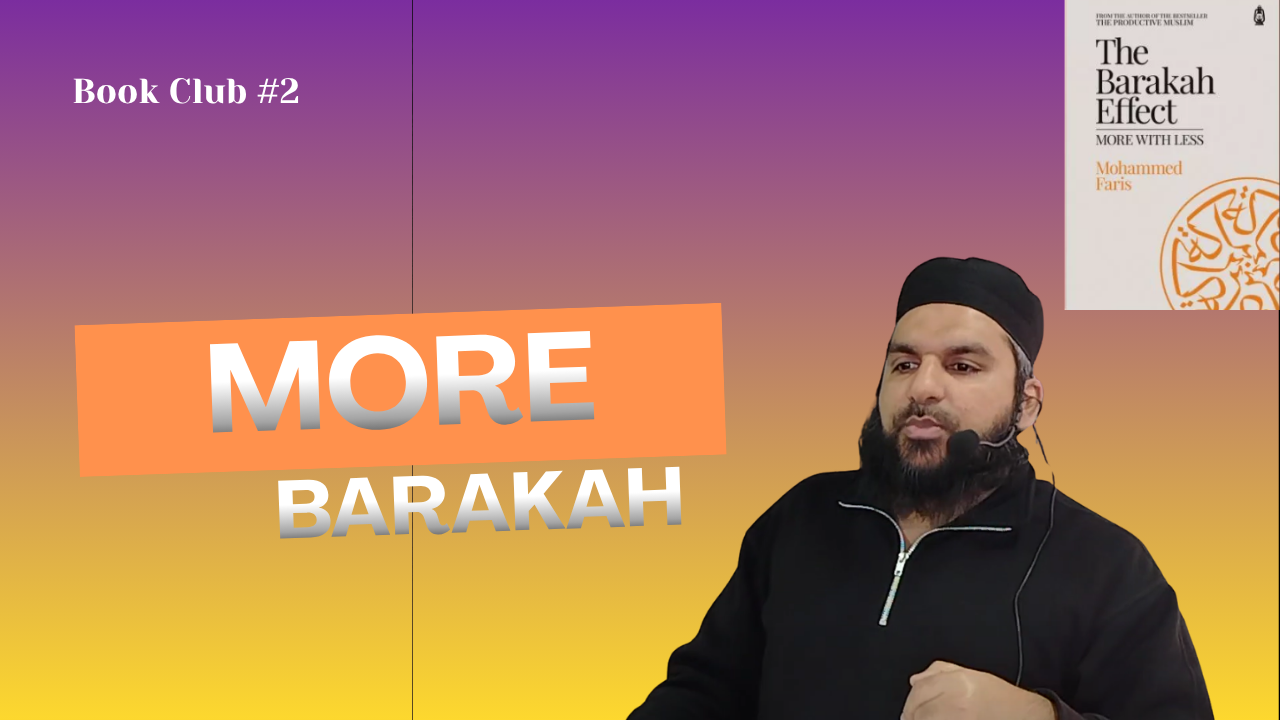
One of the most beneficial books I have read in recent years is The Barakah Effect by Muhammad Faris. Most of my favourite books are older books and classics, so it is unusual for me to find a recent book that I find this beneficial. One of the main ideas in the book is the contrast between what he calls hustle culture and Barakah culture. We live in a world that constantly tells us to hustle. Work harder. Do more. Build your career. Get the promotion. Make more money. Start a business. Build your personal brand. Become successful.
There is nothing wrong with working hard. Islam certainly does not teach laziness, and we should strive for excellence in whatever beneficial work we choose to do. The problem comes when the hustle itself becomes the purpose of our lives, when achievement becomes more important than faith, and when our entire understanding of success is based on how much we can accumulate or accomplish in this world.
Do not miss out on this exclusive opportunity to UNLOCK all our content. Become a member of Islamic Self Help and receive access to ALL our ebooks and online courses. Grab your membership here!
God-Centric vs. Ego-Centric
Muhammad Faris describes Barakah culture as God-centric and hustle culture as ego-centric, and I think this is one of the most important distinctions to understand. A Muslim’s entire life should be God-centric. Everything we do, from our work to our family life, should ultimately revolve around our relationship with Allah. Allah should be our number one priority. Hustle culture, on the other hand, tends to turn the self into the centre of everything.
It becomes about your career, your promotion, your title, your income, your achievements and your reputation. Everything revolves around “me.” This is not a healthy mindset for a Muslim. Even our good deeds can be corrupted when they become about the ego. If the purpose of doing something good is primarily to gain praise, recognition or status, then we have lost the real purpose of the deed. So the question should not simply be, “What am I achieving?” We also need to ask, “Why am I doing this?”
Purpose vs. Personal Success
Another important distinction is between being purpose-driven and being personal-success driven. Hustle culture tends to define success through things like job titles, promotions, income, expensive houses and other material achievements. Barakah culture asks a different question: How am I benefiting other people? This is something I have noticed over the years. When I spend time around people who are very driven by personal success, the conversation is often about their next goal—the next promotion, the next business milestone, the next financial target.
But when I spend time around people who are more God-centric, the conversation is often very different. They are thinking about how they can benefit other people, how they can serve the Ummah, and what they can do that will continue benefiting people even after they are gone. Sometimes this means making less money. Sometimes it means doing something for free. Sometimes it means taking on work that will never make you famous. But there is a sense of purpose behind it.
I think this is especially important today because so many people feel that their work is meaningless. They spend most of their waking hours working, but they don’t feel that their work is making any real difference. They attend meetings, fill in spreadsheets, send emails, and spend hours on tasks that ultimately seem to have no impact beyond making their employer wealthier. It is no wonder that many people feel empty. Human beings need purpose.
We need to feel that what we are doing actually matters. You may be a teacher because you feel responsible for educating the next generation. You may be a doctor because you want to improve the health of your community. You may run a business because you want to provide something useful while supporting your family and contributing to society. You may write because you want to share knowledge that benefits people. When work becomes connected to a higher purpose, it becomes more than simply a way to earn a salary.
This World vs. The Hereafter
Another obvious difference is that hustle culture is primarily focused on this world, while Barakah culture is focused on the Hereafter. Hustle culture asks, “How much money can I make? How successful can I become? How impressive can my career be? How many people can I get to follow me?” Barakah culture asks, “Is Allah pleased with me? Am I doing something beneficial? Will this work benefit me in the Hereafter?” There is nothing wrong with earning money or being successful. But those things are means, not the ultimate purpose of our lives. The ultimate goal is the pleasure of Allah and Jannah, and that should change how we think about everything else.
Acceptance vs. Results
One of the most important ideas in the book is the distinction between seeking acceptance from Allah and seeking results. This is particularly relevant to Islamic work. We have become very obsessed with results. How many people downloaded your book? How many people bought it? How many people watched the video? How many people clicked the link? How many people attended the event? How many people accepted Islam? Of course, results matter. We should want our work to benefit people, and we should evaluate whether what we are doing is actually working. But there is a danger when results become our primary measure of success.
Results are from Allah. Our job is to do beneficial work sincerely and to do it well. We make the effort, we use the means available to us, and we ask Allah to accept it. We cannot control the final outcome. Someone might spend years doing incredibly beneficial work for the Ummah and never become famous. Another person might produce something very simple and it suddenly reaches millions of people. We should strive for beneficial work and leave the results to Allah. Unfortunately, this results-driven mindset has also seeped into some Islamic organisations, where projects that may be deeply beneficial but unlikely to reach millions of people are sometimes given less attention than projects that produce impressive numbers. But the size of the audience is not necessarily a measure of the value of the work.
The Abundance Mindset
This is probably the concept from the book that I find most useful: the difference between an abundance mindset and a scarcity mindset. The abundance mindset is based on a simple belief: Allah’s treasures are limitless. Someone else becoming wealthy does not prevent Allah from making you wealthy. Someone else getting an opportunity does not mean that your opportunities have run out. Someone else’s business succeeding does not mean that your business cannot succeed. Hustle culture often creates a scarcity mindset. There are only so many customers, only so many opportunities, only so much money and only so much attention. Therefore, everyone becomes your competitor, and eventually competitors become enemies.
Imagine someone running a hot dog stall and another person opening a hot dog stall next door. In a scarcity mindset, the immediate reaction is, “I need to put that guy out of business.” But Allah can provide for both of them. You see a very different attitude in many Muslim societies. You can walk down a street and find numerous businesses selling similar things, and they don’t necessarily view each other as enemies. Sometimes you even find a shopkeeper telling a customer, “My friend has what you are looking for. Go and check his shop.” Why? Because they believe that their rizq comes from Allah. Another Muslim succeeding does not reduce what Allah can give you.
This is particularly important in Islamic work. If another Islamic organisation receives more donations than yours, why should you become angry? Allah can provide for both. If another Muslim writes a successful book, that doesn’t mean there is no audience left for your book. If someone else starts a successful educational programme, that doesn’t mean there is no room for you to contribute. There is plenty of good that needs to be done, and the Ummah needs more beneficial work, not fewer people trying to do it.
The Abundance Mindset Allows You to Think Big
The abundance mindset also gives people the courage to attempt ambitious projects. When you present a big idea to someone with a scarcity mindset, they immediately start explaining why it won’t work: “We don’t have enough money. We don’t have enough people. Who is going to fund this? The Ummah is already struggling.” But someone with an abundance mindset says, “Let’s try. Allah will provide. If this is genuinely beneficial, perhaps Allah will open the doors.” That doesn’t mean being reckless. Tawakkul does not mean ignoring reality or refusing to plan. It means doing what you can while trusting Allah with the outcome.
You might have an idea for a university, a media company, a charity, a consultancy or an educational project, but you don’t know where the funding will come from. Start with what you can. Make the effort. Ask Allah for help. If it is good for you and good for the Ummah, perhaps Allah will open doors that you never expected. And if the doors remain closed, perhaps Allah is directing you towards something better. That is a much healthier way to approach life than assuming from the beginning that there is never enough.
Gratitude Is at the Heart of Barakah
Another major part of Barakah culture is shukr, gratitude. I have spoken about gratitude for many years because I genuinely believe that it is one of the keys to a happy and blessed life. Someone who is constantly ungrateful for what Allah has already given them will struggle to experience barakah. Allah says, “If you are grateful, I will surely increase you.” (Qur’an 14:7). That increase can be understood in different ways. It can mean more blessings, more of the things we already have, or more barakah in those blessings. Either way, the principle is clear: gratitude leads to increase. If you are grateful for your income, there can be barakah in that income. If you are grateful for your family, there can be barakah in your family life. If you are grateful for your health, your time, your intelligence, your opportunities and your faith, you will begin to see these things differently.
It is easy to be grateful when everything is going well. The real test is whether you can find things to be grateful for when life is difficult. A few years ago, I went through one of the most difficult periods of my life. Despite that, I made it a habit to wake up each morning and think of things I was grateful for. There were still many blessings. I still had things to be grateful for. That experience eventually became part of the inspiration for writing 25 Keys to a Happy Life. I wanted to remind myself that even during difficult periods, there is still so much good in our lives. If you can learn to be grateful during difficult times, you will find it much easier to be grateful during the good times.
Unfortunately, we live in an age where negativity is constantly being pushed into our minds. Every day there is another crisis. The economy is collapsing. Marriage is collapsing. Housing is unaffordable. The world is getting worse. If you constantly consume this kind of content, eventually you start seeing the entire world through a lens of negativity. You stop noticing the blessings around you. This doesn’t mean that we should ignore real problems. There are genuine problems in the world, and Muslims should care about them and work to solve them. But there is a difference between acknowledging problems and becoming consumed by negativity. You have to take off the glasses of negativity and start noticing what Allah has already given you. Look around. There is probably far more good in your life than you realize. And when you begin to recognize that goodness, gratitude follows. And gratitude opens the door to barakah.
Small, Consistent Efforts
The final principle I want to focus on is small and consistent effort. This is an idea that has become very popular in modern self-help. Atomic Habits, for example, is largely built around the idea that small improvements repeated consistently over a long period of time can produce enormous results. But this is not a new idea. The Prophet ﷺ taught us that the most beloved deeds to Allah are those that are consistent, even if they are small. This is one of the keys to barakah.
People often want to do everything at once. They want to read fifty books, write a book, learn Arabic, start a business, memorise the Qur’an and completely transform their spiritual lives—all within a few weeks. Then they burn out. Islam teaches us a different approach. Do something small, do it consistently, and keep going. People sometimes ask me how I manage to read a large number of books each year. The answer is simple: I read for about thirty minutes a day. People ask how I write several books a year. I write consistently. It is not about sitting down one weekend and trying to write an entire book. It is about doing a little every day. I purposely don’t teach for many hours every day either. I believe there is more barakah in focused, thoughtful work than in constantly trying to fill every available hour.
This is also one of the reasons I have structured Islamic Self Help’s educational programmes around long-term learning. Some things can be taught in a weekend. Other things cannot. You cannot do justice to something as vast as the tafsir of Surah al-Baqarah by trying to cram it into a weekend. Sometimes the better approach is one hour a week, every week, for several years. It seems slow, but over time a tremendous amount can be accomplished. More importantly, the student has time to reflect on what they have learned, practise it and allow the knowledge to actually become part of their life. I have seen people attend intensive weekend programmes and leave extremely enthusiastic, but a few months later they remember very little of what they learned. There is nothing wrong with intensive programmes; they have their place. But for deeper subjects, consistency over a long period of time is often much more effective.
This Applies to Worship Too
The same principle applies to our spiritual lives. When someone first starts practising Islam, or when someone rediscovers their faith after a period of being distant, they can become extremely enthusiastic. They want to change everything immediately. They start praying every optional prayer, fasting constantly, reading huge amounts of Qur’an and spending hours every night in Tahajjud. Then they burn out. A better approach is to start small. If you want to pray Tahajjud, start with two rak’ahs. If you can make those two rak’ahs a consistent part of your life for decades, that is far more valuable than praying eleven rak’ahs for a few days and then giving it up completely. The same applies to Qur’an. You don’t have to read the entire Qur’an in one weekend. Read for ten minutes a day. Every day. Keep going. Over decades, those small efforts will have a tremendous impact.
Don’t Be in a Rush
I think this is one of the biggest lessons we need to take from all of this: don’t rush your life. We live in a culture of instant gratification. People want to start a business today and become millionaires within a few months. They want to write a book in a weekend. They want to master a new skill in thirty days. They want immediate results. But meaningful things take time. Writing is an art. Take your time. Teaching is an art. Take your time. Learning is a lifelong process. Building a business takes time. Developing good character takes time. Raising children takes time. Studying Islam takes time. There is nothing wrong with ambition, but ambition does not require haste. In fact, some of the greatest things in life are built slowly.
When I started Islamic Self Help, around the same time that Muhammad Faris started Productive Muslim, I knew many people who started blogs, websites, online courses and ebooks with the mindset that they would become millionaires within a year. Many of those projects disappeared within a year or two. But those of us who started with a purpose, with the goal of producing beneficial work for the Ummah and seeking the pleasure of Allah, simply kept going. We did a little bit every day. As long as the work was benefiting people, that was what mattered. A decade later, those websites and projects are still around and still benefiting people. That is the power of small and consistent effort.
A Different Way to Measure Success
Ultimately, the Barakah mindset gives us a different definition of success. Success is not simply about how much you earn. It is not about how many people know your name. It is not about how busy you are. It is not about how many followers you have. It is not even about how many impressive results you can point to at the end of the year. Success is about living a life centred around Allah, doing meaningful work, benefiting other people, being grateful for what Allah has given you, and consistently doing what you can with the abilities and opportunities He has given you.
Work hard, but don’t worship work. Be ambitious, but don’t let ambition become an obsession. Build something, but don’t build your identity around your achievements. Think big, but trust Allah with the results. Be grateful for what you already have. And don’t underestimate the power of small actions repeated consistently for many years. Perhaps we don’t need to do more. Perhaps we need to do what matters, and then keep doing it.
That is where I believe much of the barakah in life comes from.
Do not miss out on this exclusive opportunity to UNLOCK all our content. Become a member of Islamic Self Help and receive access to ALL our ebooks and online courses. Grab your membership here!